
Intraoperative Nerve Monitoring: The Technology That Protects Your Voice During Thyroid Surgery
Written by John P. Sabra, MD FACS
Updated May 2026
Educational only. This article is not medical advice. Always consult your physician about your individual situation.
Before you consent to thyroid surgery, there is one question worth asking your surgeon that most patients never think to ask: do you use intraoperative nerve monitoring?
The Nerve You Cannot Afford to Lose
The recurrent laryngeal nerve runs through the neck in close proximity to the thyroid gland on both sides. It controls the muscles of the vocal cords. When it functions normally, you speak, swallow, and breathe without thinking about it. When it is injured during thyroid surgery, the consequences range from temporary hoarseness to permanent voice loss, swallowing difficulty, or in rare bilateral cases, airway compromise. Injury to the recurrent laryngeal nerve is the most feared complication of thyroid surgery.
What Intraoperative Nerve Monitoring Actually Does
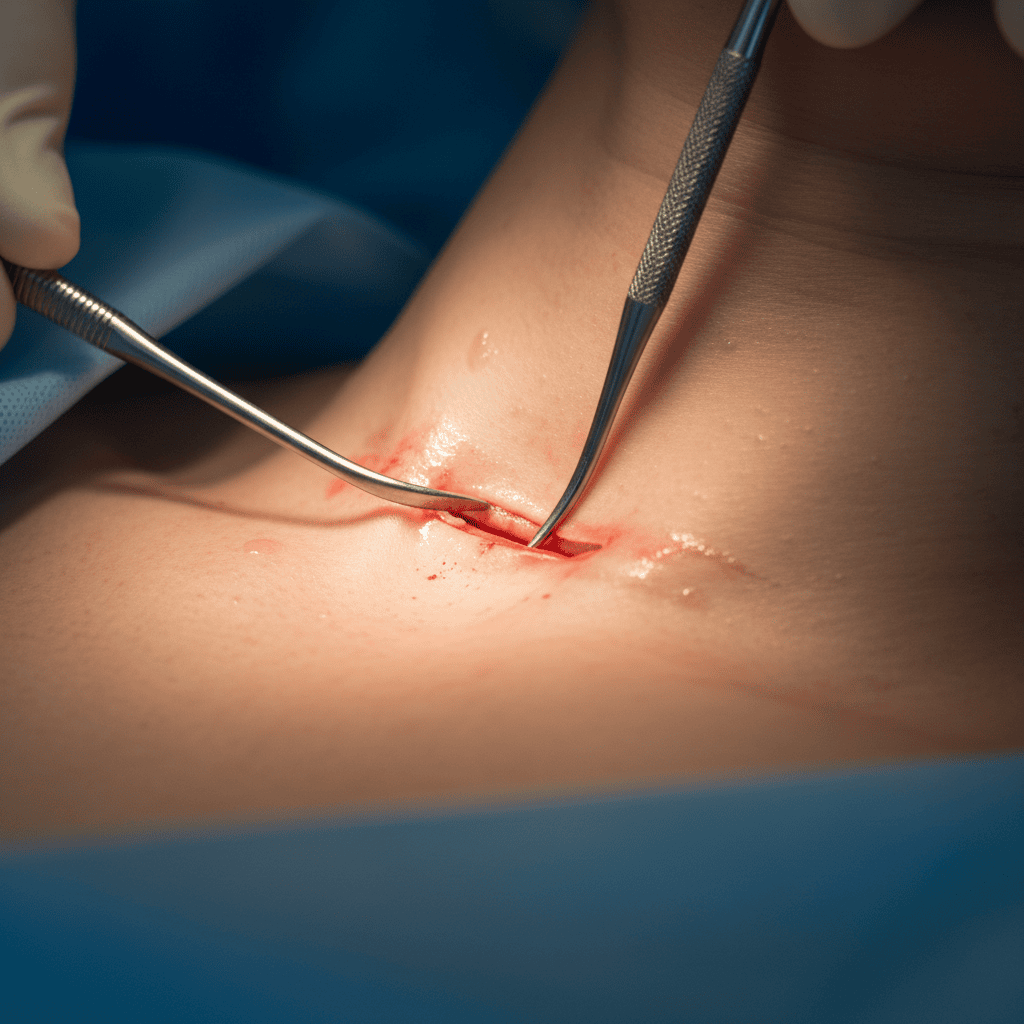
Intraoperative nerve monitoring (IONM) allows the surgeon to identify, track, and continuously assess the function of the recurrent laryngeal nerve in real time throughout the procedure. A specialized endotracheal tube with electrodes embedded in it is placed during intubation. Those electrodes make contact with the vocal cords. When the nerve is stimulated with a small handheld probe during surgery, a signal travels along the nerve to the vocal cord muscles and is recorded as an audible tone and a visual waveform on a monitor.
This does two things for the surgeon: it helps identify the nerve precisely — particularly valuable when anatomy is distorted by a large nodule, prior surgery, or inflammatory disease — and it provides continuous feedback, allowing the surgeon to detect and respond to any change in signal before a temporary stretch or compression becomes a permanent injury.
IONM is a powerful tool, but it is not a guarantee. It reduces risk; it does not eliminate it. A surgeon who uses IONM can still injure the nerve, particularly in cases with severe scarring or a tumor that has invaded the nerve itself. Patients who rely heavily on their voice professionally should discuss both the recurrent laryngeal nerve and the external branch of the superior laryngeal nerve with their surgeon before the procedure.
Why Volume and Monitoring Together Matter Most
IONM is most valuable in the hands of a surgeon who operates frequently enough to interpret its signals correctly and respond in real time. The published literature is consistent: high-volume thyroid surgeons have lower rates of recurrent laryngeal nerve injury than low-volume surgeons, and that advantage is compounded when monitoring is used alongside surgical experience. The combination of volume and IONM represents the current standard of care at the best thyroid surgery programs.
Volume thresholds that correlate with meaningfully better outcomes start at roughly 25 to 50 thyroid operations per year. Endocrine surgeons who focus exclusively on thyroid and parathyroid disease routinely exceed this.
Questions to Ask Your Surgeon Before Consenting
- Do you use intraoperative nerve monitoring for all thyroid operations? The answer should be yes, or at minimum yes for any case involving a large nodule, repeat surgery, or a nodule near the nerve.
- How many thyroid operations do you perform per year? Volume is the single strongest predictor of outcomes.
- What is your personal rate of permanent recurrent laryngeal nerve injury? Rates below 0.5% for permanent injury are consistent with published benchmarks at specialized centers.
A surgeon who is uncomfortable discussing their complication rates or who does not use nerve monitoring for routine thyroid surgery is not necessarily a bad physician. But thyroid surgery is a field where subspecialty concentration and technology adoption matter measurably for outcomes. If the answers you receive do not reflect a focused, high-volume thyroid practice using current monitoring standards, seeking a second opinion from a dedicated thyroid surgeon is a reasonable and appropriate step.
The Bottom Line
Intraoperative nerve monitoring is not an optional upgrade. It is a standard tool in the hands of thyroid surgeons who take the protection of the recurrent laryngeal nerve as seriously as the surgery itself. In the context of a high-volume, focused thyroid surgery practice, it is one of the most meaningful steps a surgeon can take to protect your voice. Ask the question before you schedule your surgery. The right surgeon will welcome it.
References
- Haugen BR, et al. 2015 ATA Management Guidelines for Thyroid Nodules and DTC. Thyroid. 2016.
- American Thyroid Association — Thyroid Surgery.
- American Association of Endocrine Surgeons — Patient Resources.
This article was written by John P. Sabra, MD FACS and is intended for patient education only. It does not constitute medical advice and does not replace a consultation with your physician. Individual patient circumstances and clinical judgment determine the appropriate surgical approach for every patient.
More from the Technology and Tools series


Ready to Talk to a Specialist?
A thyroid specialist can review your specific results, answer your questions, and help you understand exactly what your next steps should be. The ATLAS network connects you with experienced thyroid and parathyroid expert physicians who focus on thyroid disease.
Find a Thyroid Specialist Near You →