Energy Devices and Surgical Glues: The Tools That Make Thyroid Surgery Safer
Written by John P. Sabra, MD FACS
Updated May 2026
Educational only. This article is not medical advice. Always consult your physician about your individual situation.
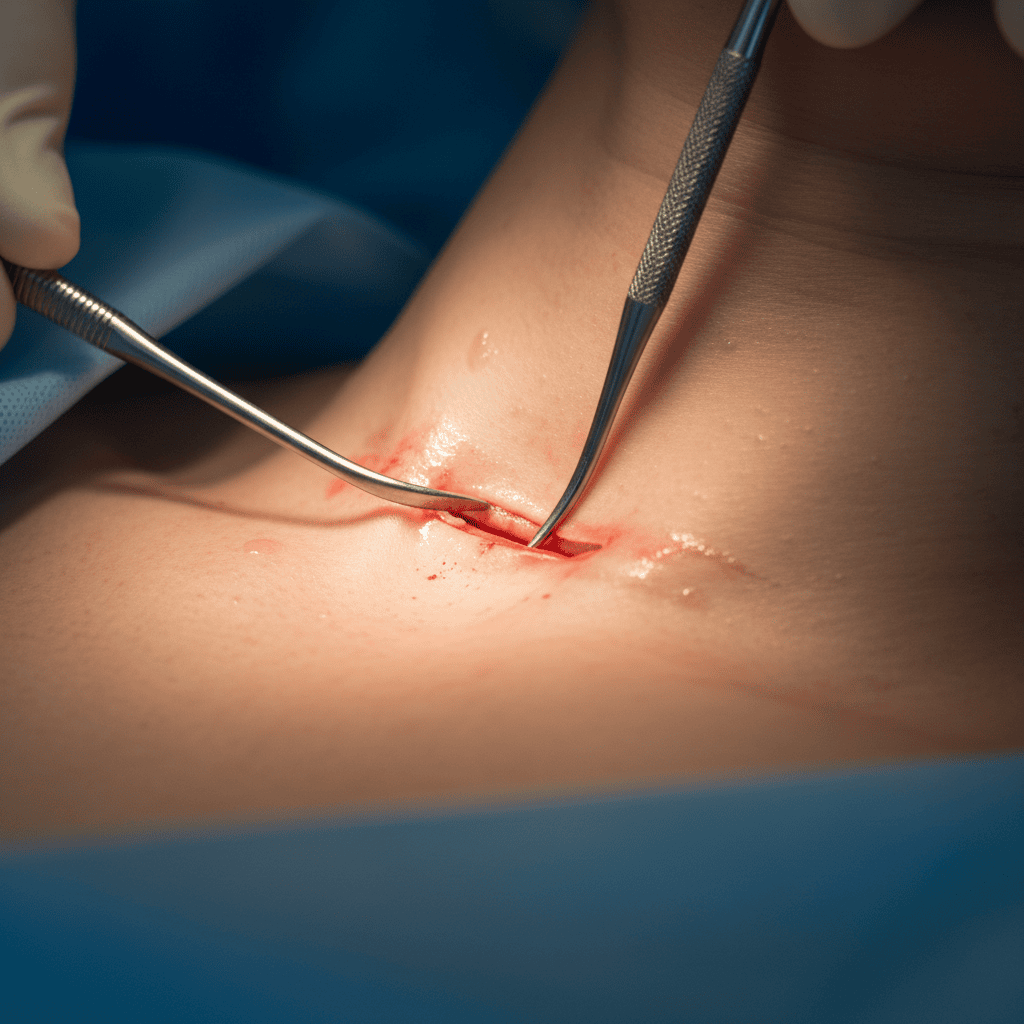
The instruments a surgeon uses inside the operating room affect what happens outside it: the risk of post-operative bleeding, how long the operation takes, and whether you go home the same day or spend the night in hospital.
Why Bleeding Control Is Central to Thyroid Surgery
The thyroid gland is one of the most vascular organs in the body relative to its size — receiving more blood flow per gram than almost any other organ. During a thyroidectomy, dozens of vessels must be sealed as the gland is dissected free. How efficiently and completely that is done determines whether the patient bleeds, how long the operation takes, and how dry the field is before closing.
Post-operative hematoma — a collection of blood in the neck after surgery — is the most serious early complication of thyroidectomy because it can compress the airway. The events that lead to it begin in the operating room, and the tools used to seal vessels are a direct factor in preventing it.
The LigaSure: How Advanced Energy Sealing Works
The LigaSure is an advanced bipolar energy device that uses radiofrequency electrical energy and pressure to seal blood vessels permanently. The device clamps the vessel, delivers a precisely controlled burst of energy, and fuses the vessel walls together by denaturing the collagen and elastin within them. The seal is strong enough to withstand arterial pressure and requires no sutures, clips, or ties.
What makes it particularly well suited to thyroid surgery: the ability to seal vessels up to 7 mm in diameter reliably, minimal thermal spread to surrounding tissue (typically less than 2 mm), and the speed with which each vessel can be addressed. In traditional surgery, each vessel requires individual identification, clamping, division, and ligation. With the LigaSure, the same vessel is sealed and divided in a single step that takes seconds.
Post-operative hematoma typically develops within the first few hours after surgery as blood pressure rises and residual oozing accumulates. A patient who goes home on the day of surgery is not in the hospital when this would be caught by nursing staff. This is precisely why the quality of intraoperative hemostasis matters so much in the era of same-day discharge. The LigaSure and similar advanced energy devices reduce the likelihood of residual bleeding by sealing vessels completely, making same-day discharge a safer option for appropriately selected patients.
Surgical Glues and Hemostatic Agents: The Final Layer
Advanced energy sealing addresses individual vessels. Surgical glues and hemostatic agents address the diffuse ooze from raw tissue surfaces that remains even after every identifiable vessel has been sealed. Products include fibrin sealants, oxidized cellulose matrices, thrombin-based agents, and polyethylene glycol hydrogel tissue sealants — each working through a different mechanism to accelerate clot formation and provide a physical barrier over bleeding surfaces.
Used together with energy sealing rather than as a substitute for it, these agents provide a meaningful additional layer of protection. The surgeon who uses both is addressing two distinct mechanisms of post-operative bleeding with two distinct tools.
The Combination That Makes Same-Day Surgery Possible
A generation ago, thyroidectomy was always a one-night hospital stay. Today, same-day discharge after uncomplicated thyroidectomy is routine at high-volume thyroid surgery centers — and the technology available in the operating room is a significant part of why.
- Advanced energy sealing — eliminates individual vessel ligation, produces reliable hemostasis across all vessel sizes, and reduces operating time
- Hemostatic glues and agents — address diffuse tissue surface bleeding as a complement to energy sealing
- Meticulous surgical technique — technology amplifies skill but does not substitute for it
- Careful patient selection — patients on blood thinners, with large goiters, or undergoing extended dissections are evaluated individually and may need to stay overnight
Ask your surgeon whether they use advanced energy sealing devices such as the LigaSure as part of their standard operative technique, and whether they use topical hemostatic agents routinely. The answer tells you something about whether their practice is operating at the current standard of care or relying on techniques that have not evolved in decades.
The Bottom Line
No single tool makes thyroid surgery safe. What makes thyroid surgery safe is the systematic application of current best practices across every step. Advanced energy devices and surgical glues are evidence-supported tools that experienced thyroid surgeons have integrated into their practice because patients recover better when bleeding is controlled completely in the operating room. Ask whether your surgeon uses them. The answer is a window into how they approach the details of your care.
References
- Haugen BR, et al. 2015 ATA Management Guidelines for Thyroid Nodules and DTC. Thyroid. 2016.
- American Thyroid Association — Thyroid Surgery.
- American Association of Endocrine Surgeons — Patient Resources.
This article was written by John P. Sabra, MD FACS and is intended for patient education only. It does not constitute medical advice and does not replace a consultation with your physician.
More from the Technology and Tools series



Ready to Talk to a Specialist?
A thyroid specialist can review your specific results, answer your questions, and help you understand exactly what your next steps should be. The ATLAS network connects you with experienced thyroid and parathyroid expert physicians who focus on thyroid disease.
Find a Thyroid Specialist Near You →