
Bethesda 6: Malignant biopsy result and what comes next
Written by John P. Sabra, MD, FACS | Updated May 2026
Educational only. This article is not medical advice. Always consult your physician about your individual situation.
A Bethesda 6 result confirms thyroid cancer with a probability greater than 97%. This is a frightening result to read on a piece of paper. It is also, in most cases, one of the more treatable diagnoses in cancer medicine, with five-year survival above 98% for the most common type.
If you have just received a Bethesda 6 result, the next several weeks will move quickly: imaging, surgical consultation, decisions about the operation, and the operation itself. The goal of this article is to give you a clear map of what comes next, what your real options are, and what concrete steps you can take this week to put yourself in the best possible position. If you have not read the overview, see the Bethesda system guide for context on all six categories.
What Bethesda 6 Means
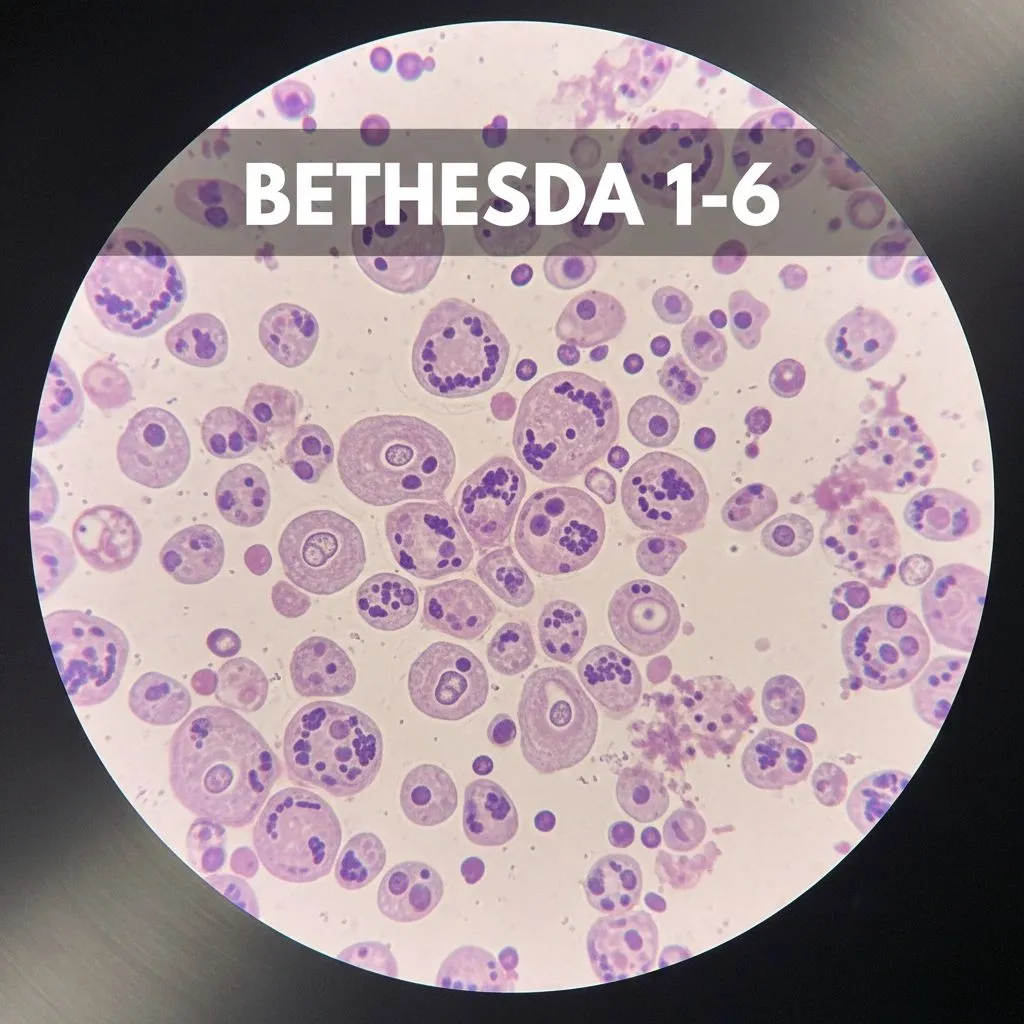
The Bethesda System classifies thyroid biopsy results from 1 (non-diagnostic) to 6 (malignant). Bethesda 6 is the highest category and indicates that the cytopathologist looking at your biopsy slide saw cells with the diagnostic features of cancer. Across published series, the malignancy rate for Bethesda 6 results runs 97 to 99% on final surgical pathology.
This means a Bethesda 6 result is, in practice, a confirmed cancer diagnosis. Surgery is the next step in essentially all cases. The decisions ahead are about which operation, when, and with whom, not whether to operate.
Bethesda 6 differs from Bethesda 5 (suspicious for malignancy) in one critical way: certainty. A Bethesda 5 result carries a 60 to 75% cancer risk, leaving meaningful uncertainty until surgery is complete. A Bethesda 6 result removes that uncertainty and changes the question from “is this cancer” to “what comes next.”
The Cancer Types Behind a Bethesda 6 Result
Most thyroid cancers fall into one of four main categories, and the prognosis varies dramatically across them.
| Type | Roughly | 5-year survival | Notes |
|---|---|---|---|
| Papillary (PTC) | 80 to 85% of cases | Above 98% for early stage | The most common type. Slow growing. Excellent prognosis when treated. Can spread to neck lymph nodes. |
| Follicular | 10 to 15% | Above 90% for early stage | Slightly more aggressive than papillary. Often spreads through the bloodstream rather than lymph nodes. |
| Medullary (MTC) | 1 to 2% | Approximately 80% | Arises from C-cells. Sometimes hereditary. Requires calcitonin and CEA monitoring. |
| Anaplastic | Less than 1% | Approximately 5 to 10% | Aggressive. Requires urgent treatment by a multidisciplinary team. |
Most patients reading this article have papillary thyroid cancer, and the data on papillary cancer is some of the most reassuring in oncology. Localized papillary cancer treated promptly has a five-year survival above 98%, and ten-year survival remains over 95%. The reason for the strong prognosis is that papillary cancer grows slowly, responds well to surgery, and behaves predictably.
| ⚕ Clinical note Five-year survival numbers are population statistics, not individual predictions. Two patients with the same cancer type can have very different outcomes depending on stage, age, the presence of lymph node involvement, and how completely the cancer is removed. Individual prognosis becomes much clearer after surgery, when final pathology characterizes the tumor in full detail. |
|---|
What Happens in the Next Two Weeks
After a Bethesda 6 result, the typical sequence is:
- Comprehensive neck ultrasound to map the thyroid and check for abnormal lymph nodes (if not already performed)
- Surgical consultation to discuss the operation, the extent of surgery, and the surgeon’s experience
- Optional second opinion if you want one (and you can ask for one without offending anyone)
- Molecular testing of the biopsy sample, can influence the extent of the surgery
- Pre-operative blood work and sometimes vocal cord assessment
- Surgery, typically scheduled within several weeks of diagnosis
Most thyroid cancers do not require emergency surgery. There is time to do the diagnostic and planning steps thoughtfully. Anaplastic thyroid cancer is the exception, where treatment must begin within days of diagnosis.
The Surgery Decisions Ahead
The two main thyroid operations for cancer are thyroid lobectomy and total thyroidectomy. The choice depends on tumor size, the presence of lymph node involvement, the type of cancer, your overall health, and your preferences.
Lobectomy removes the lobe containing the cancer. It is appropriate for many low-risk papillary cancers under 4 cm without lymph node spread, and it preserves the patient’s ability to make thyroid hormone, sometimes avoiding the need for lifelong replacement medication.
Total thyroidectomy removes the entire thyroid gland. It is recommended for tumors greater than 4 cm, for cancers with concerning features (extension outside the thyroid, lymph node involvement, aggressive variants), for medullary cancer, and for some hereditary settings.
Central neck dissection removes the lymph nodes in the central neck. It is added to the primary operation when there is evidence (clinical or imaging) of lymph node involvement, and is sometimes performed prophylactically in higher-risk cancers.
Radioactive iodine (RAI) is sometimes given several weeks after a total thyroidectomy to destroy any remaining thyroid tissue or microscopic cancer. It is used selectively, not routinely, and the decision is made based on the final pathology of your tumor.
Five Things You Should Do This Week
If you want concrete steps you can take right now, here are five that consistently improve outcomes for thyroid cancer patients:
- 1. Find a high-volume thyroid surgeon. Outcomes for thyroid surgery, including cure rates and complication rates, are strongly correlated with how often the surgeon performs the operation. A surgeon performing more than 25 to 30 thyroid operations per year has measurably better results than a surgeon performing fewer than 10.
- 2. Get the biopsy slides reviewed if there is any doubt. Pathology review by a thyroid-specialty cytopathologist sometimes changes the diagnosis or refines the cancer type, particularly for unusual variants. Ask your surgeon if a second pathology review is needed in your case.
- 3. Ask about molecular testing. Molecular tests can identify mutations (BRAF, RAS, TERT, RET) that affect prognosis, the extent of recommended surgery, and possible future therapy. Not every Bethesda 6 case needs molecular testing, but many benefit from it.
- 4. Schedule a second opinion if you want one. A second opinion is standard practice in cancer medicine and most thyroid surgeons expect their patients to seek one. The opinion can confirm the surgical plan or surface options that were not discussed in the first visit.
- 5. Get specific about your stage and pathology. Ask for a copy of your biopsy report, your imaging reports, and any pathology reports. Knowing your specific cancer type, tumor size, and any nodal involvement helps you ask better questions and process the diagnosis with clarity.
How to Find the Right Surgeon
Surgeon selection is the single most controllable variable in your outcome. The factors that matter most are case volume (how many thyroid operations performed per year), specialization (whether thyroid surgery is the bulk of the surgeon’s practice), use of safety adjuncts such as nerve monitoring and parathyroid identification technology, and clear willingness to discuss specific personal complication rates.
Volume thresholds matter. Surgeons performing more than 25 to 30 thyroid surgeries per year achieve significantly better outcomes than lower-volume surgeons, and surgeons performing more than 100 per year improve further.
The Bottom Line
A Bethesda 6 result confirms thyroid cancer. For most patients, this means papillary thyroid cancer, which is highly treatable and carries an excellent long-term prognosis when surgery is performed by a high-volume specialist. The next several weeks involve imaging, consultation, surgical planning, and surgery itself.
The diagnosis is real, but the data is on your side, and the decisions you make in the next two weeks (which surgeon, which operation, what additional testing) will shape your outcome more than almost anything that follows. Take a breath, gather information, and use the time you have to choose carefully.
References
- Haugen BR, et al. 2015 ATA Management Guidelines for Thyroid Nodules and DTC. Thyroid. 2016.
- American Thyroid Association — Thyroid Cancer.
- National Cancer Institute — Thyroid Cancer Treatment.
This article was written by John P. Sabra, MD FACS, and is intended for patient education only. It does not constitute medical advice and does not replace a consultation with your physician.
More from the Needle Biopsy (FNA) series

Ready to Talk to a Specialist?
A thyroid specialist can review your specific results, answer your questions, and help you understand exactly what your next steps should be. The ATLAS network connects you with experienced thyroid and parathyroid expert physicians who focus on thyroid disease.
Find a Thyroid Specialist Near You →