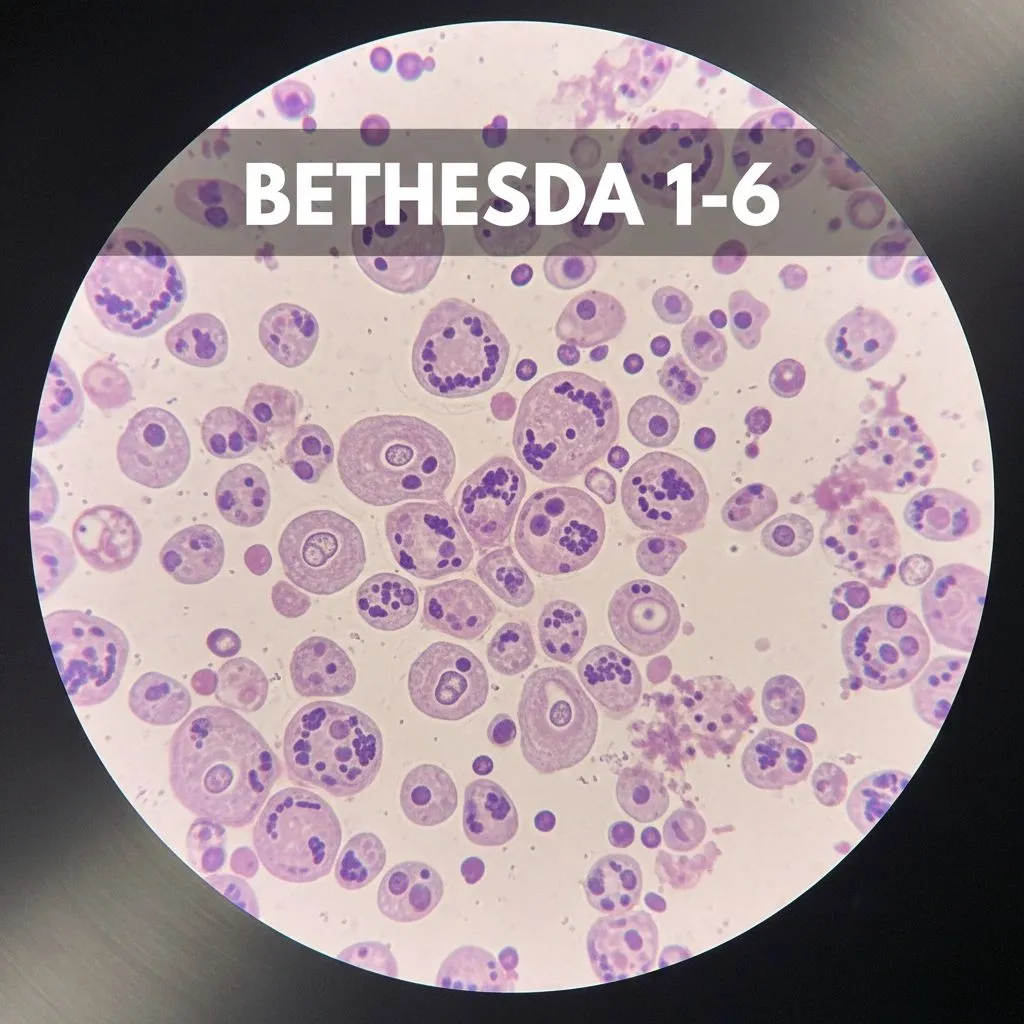
Your Thyroid Biopsy Results Explained: A Patient Guide to the Bethesda System
Written by John P. Sabra, MD FACS
Updated May 2026
Educational only. This article is not medical advice. Always consult your physician about your individual situation.
You had the biopsy. You waited several days. And now the result has arrived containing a word or Roman numeral that means nothing to you. Bethesda II. Bethesda IV. Indeterminate. Non-diagnostic. This article is that translation — all six Bethesda categories in plain English.
What the Bethesda System Is
The Bethesda System for Reporting Thyroid Cytopathology is a standardized classification framework introduced in 2007 to ensure biopsy results are communicated consistently across pathologists, institutions, and doctors. It replaced widely inconsistent terminology with six defined categories, each with a Roman numeral, a name, an estimated malignancy risk range, and a general management recommendation.
The Bethesda System uses risk ranges rather than single numbers because malignancy risk genuinely varies across institutions and pathologist experience. Your physician can give you a more specific estimate based on where your biopsy was performed.
The Six Bethesda Categories at a Glance
| Category | Name | Malignancy Risk | Typical Next Step |
|---|---|---|---|
| I | Non-diagnostic | 1–4% | Repeat biopsy with technique adjustment |
| II | Benign | 0–3% | Surveillance ultrasound at defined intervals |
| III | AUS/FLUS | 10–30% | Repeat biopsy or molecular testing |
| IV | Follicular Neoplasm | 25–40% | Molecular testing or diagnostic lobectomy |
| V | Suspicious for Malignancy | 50–75% | Surgical referral |
| VI | Malignant | 97–99% | Surgical referral and treatment planning |
Bethesda I: Non-Diagnostic
It is not a cancer finding. The pathologist did not receive enough well-preserved cells to make a reliable classification — a procedural outcome, not a finding about the nodule itself. The standard recommendation is a repeat biopsy with a technical adjustment. A second biopsy under experienced hands produces a diagnostic result in the majority of cases.
Bethesda II: Benign
Bethesda II is the result the overwhelming majority of patients receive. The pathologist found nothing to suggest cancer. The malignancy risk is 0 to 3%. A Bethesda II result is very good news — it transitions the nodule from active evaluation to routine surveillance. For patients with a large symptomatic benign nodule, this result also opens the door to non-surgical treatment such as RFA.
Bethesda III: Atypia of Undetermined Significance (AUS/FLUS)
One of the two indeterminate categories. The cells show some abnormal features, but not enough to be classified as clearly benign or clearly malignant. Malignancy risk is 10 to 30% — the majority of Bethesda III nodules are ultimately found to be benign. The three main options are repeat biopsy, molecular testing, or diagnostic surgery.
Bethesda IV: Follicular Neoplasm
The second indeterminate category, with a malignancy risk of 25 to 40%. The biopsy shows a follicular cell pattern that could represent either a benign adenoma or a follicular carcinoma — a distinction that cannot be made on cytology alone. Molecular testing (Afirma, ThyroSeq) can reclassify many Bethesda IV nodules as likely benign, potentially avoiding surgery.
Bethesda III and IV are both indeterminate, but they are not equivalent. Bethesda IV has a higher and more consistent malignancy risk and is more likely to lead directly to surgical evaluation. Ask your physician specifically which subcategory applies.
Bethesda V: Suspicious for Malignancy
The pathologist identified cells with features strongly associated with cancer, but the sample did not meet the full criteria for a definitive malignant diagnosis. Malignancy risk is 50 to 75%. Bethesda V is a high-suspicion finding, not a confirmed cancer diagnosis. Surgical referral is standard next step.
Bethesda VI: Malignant
Cancer cells were identified. Malignancy risk is 97 to 99%. A thyroid cancer diagnosis is not a worst-case scenario. Papillary thyroid carcinoma — the most common type — has a five-year survival rate exceeding 98% for most patients. For many low-risk papillary thyroid cancers, lobectomy (removal of the affected half of the thyroid) is now an appropriate and increasingly preferred option, often preserving thyroid function and avoiding lifelong hormone replacement.
The ten-year survival rate for papillary thyroid cancer is over 95% even for patients with some lymph node involvement. Many patients now have the option of active surveillance rather than immediate surgery.
The Bottom Line
Whatever category your result falls into, it carries a specific meaning, a specific risk range, and a specific set of options. The most common result is Bethesda II — good news. The indeterminate categories have well-established pathways through molecular testing and diagnostic surgery. The higher categories lead to clear treatment plans with excellent outcomes for most patients.
References
- Haugen BR, et al. 2015 ATA Management Guidelines for Thyroid Nodules and DTC. Thyroid. 2016.
- American Thyroid Association — Fine-Needle Aspiration Biopsy of Thyroid Nodules.
- National Cancer Institute — Thyroid Cancer.
This article was written by John P. Sabra, MD FACS and is intended for patient education only. It does not constitute medical advice and does not replace a consultation with your physician.
More from the Needle Biopsy (FNA) series


Ready to Talk to a Specialist?
A thyroid specialist can review your specific results, answer your questions, and help you understand exactly what your next steps should be. The ATLAS network connects you with experienced thyroid and parathyroid expert physicians who focus on thyroid disease.
Find a Thyroid Specialist Near You →