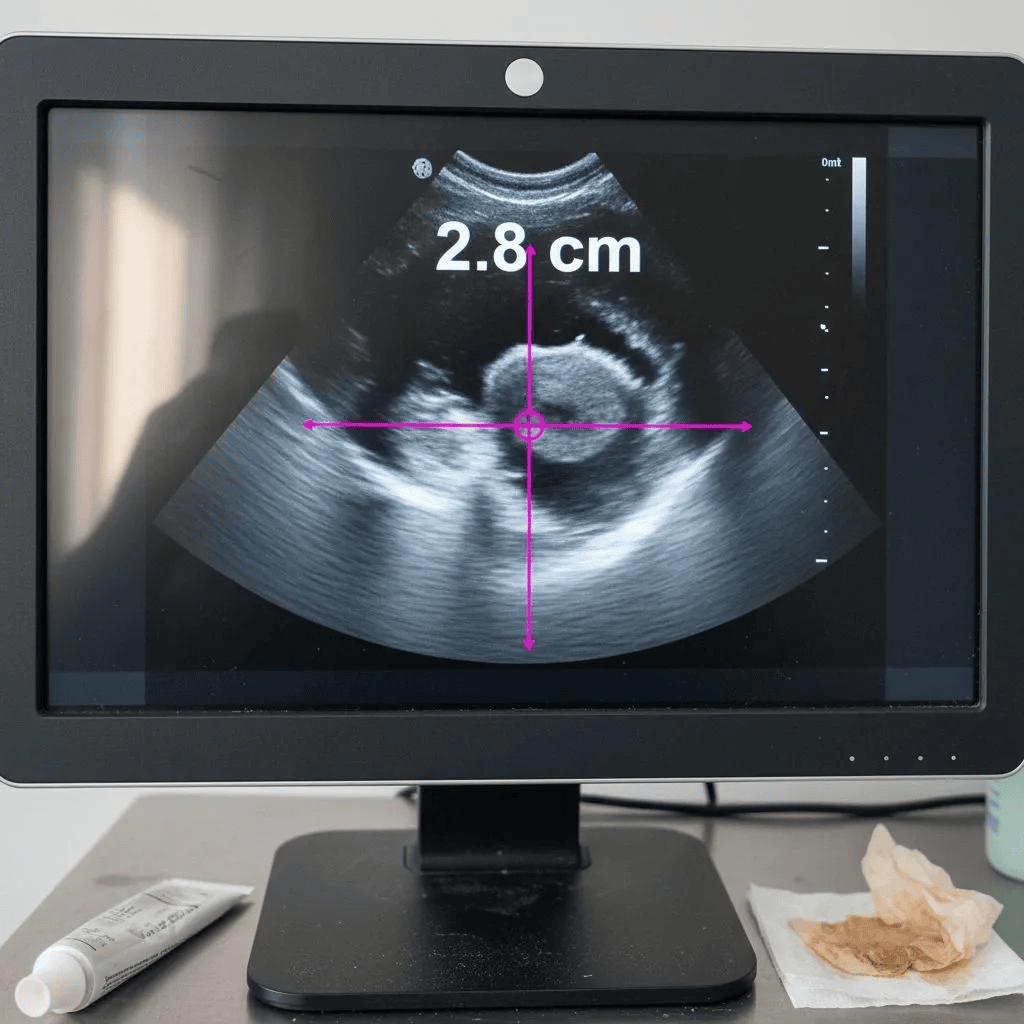
Thyroid Nodule Size: Does It Actually Tell You If It’s Cancer?
Written by John P. Sabra, MD FACS
Updated May 2026
Educational only. This article is not medical advice. Always consult your physician about your individual situation.
“My nodule is 3 cm. Does that mean it’s more likely to be cancer?”
This is one of the most common questions from patients in their first appointment, and it is one of the most important misconceptions to address early. The answer, for the large majority of thyroid nodules, is no. Size and malignancy risk are largely independent of each other. A 3 cm nodule is not inherently more likely to be cancerous than a 1 cm nodule with the same ultrasound features. What drives cancer risk is what the nodule looks like on ultrasound, not how large it is.
This matters because size anxiety is one of the most common reasons patients arrive at specialist appointments already convinced their situation is serious when the evidence does not support that conclusion. Understanding the relationship between size, features, and risk is one of the most useful things you can take away from your ultrasound report.
What Actually Drives Malignancy Risk: Features, Not Size
The TIRADS scoring system, which is the framework your radiologist uses to classify your nodule, is built entirely on five ultrasound features: composition, echogenicity, shape, margins, and echogenic foci. Not a single one of these five categories involves size. The malignancy risk associated with your TR score is driven by how the nodule looks, not how large it has grown.
This is not a technicality. It reflects the actual biology of thyroid nodules. Malignant nodules are identified by specific visual characteristics that appear under ultrasound regardless of size. A small papillary thyroid cancer is identifiable by its marked hypoechogenicity, irregular margins, or microcalcifications long before it reaches a worrying size. A large benign colloid nodule can grow to 4 or 5 cm and retain entirely reassuring features throughout.
Size tells you how big the nodule is. Features tell you what it is.
When Size Does Matter: The FNA Threshold
Size is not irrelevant. It plays an important and specific role in thyroid nodule management — just not the role most patients assume. The primary job of nodule size in the TIRADS framework is to determine when a biopsy is recommended for each suspicion category.
| TIRADS Level | Malignancy Risk | FNA Threshold | What This Tells Us About Size vs. Risk |
|---|---|---|---|
| TR3 | ~5% | ≥ 2.5 cm | A 3 cm TR3 nodule and a 1 cm TR3 nodule carry roughly the same malignancy risk. Size triggers the biopsy decision at 2.5 cm, but it does not change the underlying cancer probability. |
| TR4 | 6 to 17% | ≥ 1.5 cm | A TR4 nodule at 2 cm and a TR4 nodule at 1 cm carry similar malignancy risk per their features. The 1.5 cm threshold determines whether biopsy is recommended, not what the risk level is. |
| TR5 | 20 to 35%+ | ≥ 1.0 cm | Even at TR5, size does not change the malignancy probability. A 1.2 cm TR5 nodule and a 3 cm TR5 nodule both have the same estimated risk range. Size determines when to act, not how worried to be. |
The size threshold changes across TR categories because higher-suspicion nodules warrant earlier action. But within each category, the malignancy risk does not change based on size. A TR3 nodule at 1.5 cm and a TR3 nodule at 3 cm carry approximately the same cancer probability. The larger nodule gets biopsied because the guidelines set a size trigger for action, not because the larger nodule is more dangerous.
The 4 cm Threshold: When Size Becomes Its Own Reason to Act
While size does not drive malignancy risk for most nodules, there is a specific size threshold where it becomes a clinical concern in its own right: 4 cm. Nodules that reach 4 cm or larger typically warrant surgical consideration regardless of their TIRADS score or biopsy result. There are two reasons for this.
- Biopsy accuracy decreases at very large sizes: A fine needle aspiration samples only a small portion of the nodule. For nodules above 4 cm, that sample may not be representative of the nodule as a whole. A benign FNA result on a 5 cm nodule carries a higher false-negative rate than the same result on a 2 cm nodule, which means the reassurance it provides is less reliable.
- Compressive symptoms become more likely: Regardless of whether a large nodule is benign or malignant, a nodule at 4 cm or more has the potential to compress surrounding structures including the trachea, esophagus, and blood vessels. Difficulty swallowing, a sense of pressure in the neck, voice changes, or visible neck bulging are all symptoms that warrant treatment consideration independent of the cancer question.
For patients with a large benign nodule causing symptoms or cosmetic concern, radiofrequency ablation (RFA) is an increasingly available non-surgical option that can significantly reduce nodule volume without removing the thyroid. The nodule first needs a confirmed benign biopsy result — one more reason why biopsy matters even for lower-suspicion large nodules.
Putting Size in Perspective: A Practical Reference
Centimeters are abstract until you have something to compare them to. The table below provides a practical size reference alongside the clinical significance of each range.
| Size | Common Reference | TIRADS Relevance | What It Means Practically |
|---|---|---|---|
| Under 0.5 cm | Pea | All categories | Very small nodules are not typically biopsied regardless of TIRADS score. The absolute risk of a clinically significant cancer at this size is extremely low. |
| 0.5 to 1.0 cm | Blueberry | TR5 threshold | TR5 nodules in this range are watched with imaging rather than biopsied in most cases. Other categories do not require biopsy at this size. |
| 1.0 to 1.5 cm | Grape | TR4/TR5 range | TR5 nodules at or above 1.0 cm are typically recommended for biopsy. TR4 nodules at this size remain on surveillance in most cases. |
| 1.5 to 2.5 cm | Olive to cherry | TR3/TR4 range | TR4 nodules at or above 1.5 cm are generally recommended for biopsy. TR3 nodules in this range are still below the 2.5 cm FNA threshold. |
| 2.5 to 4.0 cm | Large olive to grape | TR3 threshold | TR3 nodules at or above 2.5 cm are considered for biopsy. At this size, even lower-suspicion nodules may warrant evaluation for symptoms or RFA candidacy. |
| 4.0 cm or more | Golf ball range | All categories | Surgical consideration is typically appropriate at this size regardless of TIRADS score or biopsy result. Biopsy accuracy decreases for very large nodules, and compressive symptoms become more likely. |
The “Dominant Nodule”: A Term Worth Understanding
If you have multiple thyroid nodules and have been told that one of them is the “dominant nodule,” you may have assumed that the dominant nodule is the one most likely to be cancerous or the one that requires the most attention. This is a common and understandable misreading of the term.
In traditional thyroid practice, “dominant nodule” simply meant the largest nodule in the gland. The American College of Radiology now explicitly discourages the use of this term in TIRADS reporting because it has led to exactly this kind of confusion, and because it can lead to the wrong nodule being biopsied.
Under ACR TIRADS guidelines, the nodule that drives evaluation and biopsy decisions is the most suspicious nodule based on its features, not the largest nodule. A 1 cm TR4 nodule and a 3 cm TR2 nodule in the same patient are not equal in clinical priority. The 1 cm TR4 nodule, despite being smaller, is the one that warrants closer attention because its features carry a higher malignancy risk.
If your report or physician refers to a dominant nodule, ask specifically which nodule has the highest TIRADS score and what the features driving that score are. That is the conversation worth having, regardless of which nodule is largest.
Size and Symptoms: The Other Reason Size Matters
Beyond biopsy thresholds and the 4 cm rule, there is a third dimension to the size question that has nothing to do with cancer risk: symptoms.
A nodule of any size can potentially cause symptoms if it is positioned near sensitive structures in the neck. Pressure on the trachea can produce a sensation of throat fullness or difficulty breathing. Pressure on the esophagus can cause mild difficulty swallowing. Proximity to the recurrent laryngeal nerve can, in some cases, affect the voice. Visible neck prominence can create cosmetic concern.
These symptoms are worth discussing with your physician regardless of what your TIRADS score shows, and regardless of whether the nodule is below the biopsy threshold. A symptomatic benign nodule may be an excellent candidate for non-surgical treatment. A nodule causing no symptoms at all, even a large one, may be appropriately managed with continued surveillance. The symptom conversation and the cancer risk conversation are related but separate, and both deserve attention in your appointment.
The Bottom Line
Nodule size is not a reliable indicator of malignancy risk in the way most patients assume. For the vast majority of thyroid nodules below 4 cm, what drives the cancer probability is the constellation of ultrasound features that produce the TIRADS score, not the centimeter measurement at the top of the report.
Size does matter in two specific and important ways. It determines when each TIRADS category crosses the threshold for biopsy. And it becomes a clinical concern in its own right at 4 cm or above, where surgical consideration is typically appropriate regardless of features or biopsy results. Outside of those two roles, a large nodule with reassuring features is not more worrying than a small one with the same features.
References
- Haugen BR, et al. 2015 ATA Management Guidelines for Thyroid Nodules and DTC. Thyroid. 2016.
- Tessler FN, et al. ACR TI-RADS White Paper. J Am Coll Radiol. 2017.
- National Cancer Institute — Thyroid Cancer.
This article was written by John P. Sabra, MD FACS and is intended for patient education only. It does not constitute medical advice and does not replace a consultation with your physician. TIRADS categories are clinical guidelines, not mandatory rules. Individual nodule characteristics, patient health history, age, risk factors, and clinical judgment all determine the appropriate management for every patient.
More from the Ultrasound series


Ready to Talk to a Specialist?
A thyroid specialist can review your specific results, answer your questions, and help you understand exactly what your next steps should be. The ATLAS network connects you with experienced thyroid and parathyroid expert physicians who focus on thyroid disease.
Find a Thyroid Specialist Near You →