Thyroid Nodule Treatment Without Surgery: What Is RFA (and other energy ablation alternatives) and Am I a Candidate?
Written by John P. Sabra, MD FACS
Updated May 2026
Educational only. This article is not medical advice. Always consult your physician about your individual situation.
“My doctor said I need to do something about my thyroid nodule. Does it have to be surgery?”
For many patients, the answer is no. For a significant and growing number of patients with benign thyroid nodules, radiofrequency ablation, known as RFA, is a clinically proven, minimally invasive alternative that shrinks the nodule without removing the thyroid, without general anesthesia, and without the recovery time of surgery. There are also multiple other energy ablation sources such as microwave and laser devices that offer similar platforms to deliver energy.
What Radiofrequency Ablation (RFA) Actually Is
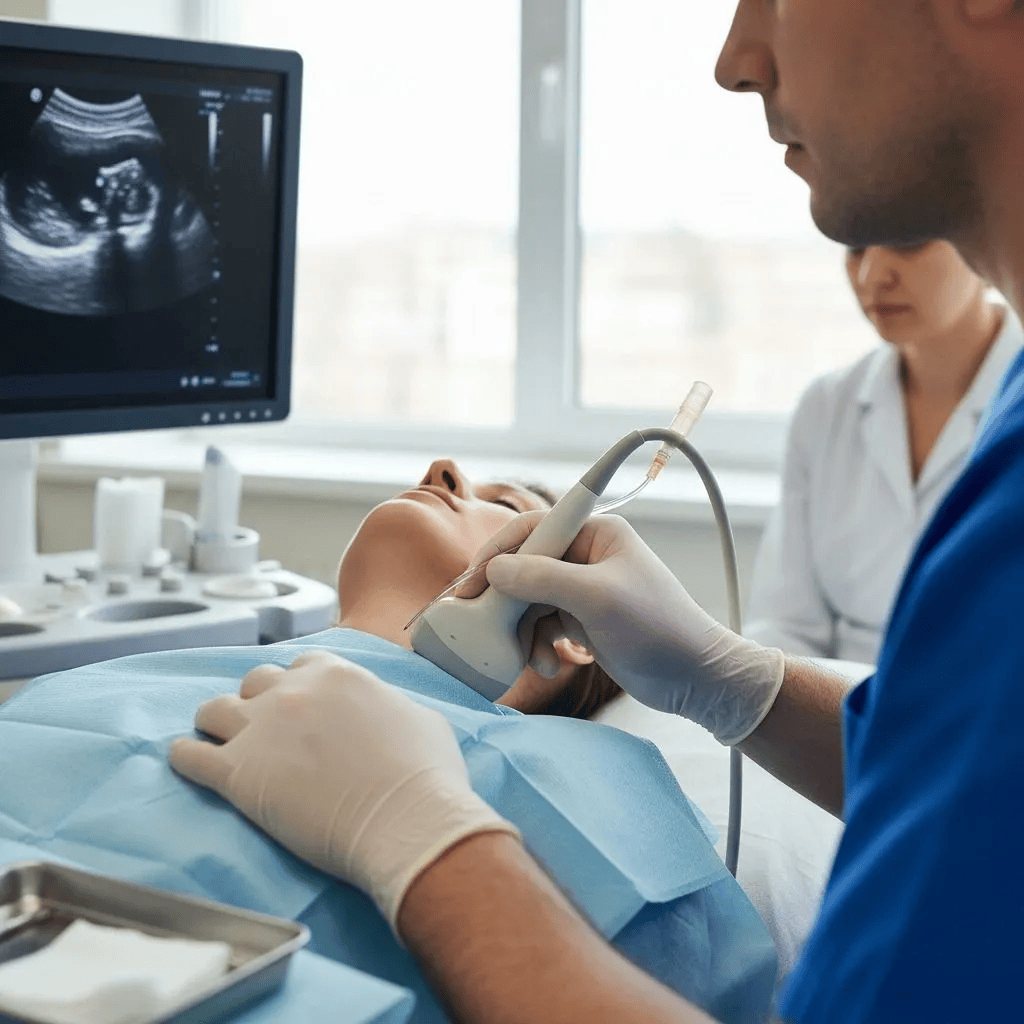
RFA is a minimally invasive procedure in which a thin electrode, similar in size to a large needle, is guided into the thyroid nodule under real-time ultrasound visualization. The tip generates heat using radiofrequency energy, which destroys the cells within the nodule from the inside. Other energy platforms such as microwave and laser devices deliver energy to the tip of similar electrodes, just using a different type of energy. All of them aim to accomplish a simple task: destroy thyroid cells using heat energy. The treated tissue is gradually absorbed by the body over the following weeks and months, and the nodule shrinks progressively.
The procedure is performed under local anesthetic in an office or outpatient setting. No incision, no general anesthesia, no thyroid removal, no hospital admission. Most patients leave the office and return to normal activities the same or next day. Clinical studies show an average nodule volume reduction >50% over 6 to 12 months. RFA treats the nodule without removing the thyroid.
RFA is not new technology. Radiofrequency ablation has been performed for thyroid nodules in South Korea, Europe, and parts of Asia for over 15 years. The FDA cleared RFA for benign thyroid nodule treatment in the United States in 2018. Its availability in the US is growing but is not yet universal. If your current physician has not mentioned RFA, it does not mean it is unavailable — it may mean your physician has not trained in the technique.
Who Is a Candidate for RFA — and Who Is Not
| Good RFA Candidate | RFA Is Not Appropriate |
|---|---|
| Biopsy-confirmed benign nodule (ideally two benign FNA results) | Confirmed or suspected malignancy on biopsy |
| Solid or predominantly solid composition | Predominantly cystic nodule (ethanol ablation is preferred) |
| Symptomatic nodule causing pressure, swallowing difficulty, or voice changes | High-suspicion ultrasound features that have not yet been fully evaluated with biopsy |
| Cosmetic concern from a visible or growing nodule | Nodule in a location that makes safe electrode placement technically difficult |
| Patient prefers to preserve thyroid function and avoid surgery | Prior surgery or radiation to the neck in some circumstances — requires expert evaluation |
RFA vs. Surgery: A Direct Comparison
| Dimension | Radiofrequency Ablation (RFA) | Thyroid Surgery |
|---|---|---|
| Anesthesia | Local anesthetic only. Patient is awake throughout. | General anesthesia required. Patient is fully sedated. |
| Incision and scarring | No incision. No visible scar. | A horizontal incision in the lower neck. Scarring is typically minimal but permanent. |
| Thyroid removal | The thyroid is not removed. Only nodule tissue is destroyed. | Part or all of the thyroid is surgically removed. |
| Thyroid function | Preserved in the vast majority of patients. Hormone medication rarely needed. | Lobectomy may preserve function; total thyroidectomy requires lifelong hormone medication. |
| Recovery time | Most patients return to normal activities within 24 hours. | Recovery typically takes 1 to 2 weeks. |
| Nodule outcome | Nodule shrinks >50% over 6 to 12 months. Not physically removed. | Nodule and surrounding thyroid tissue removed entirely and sent for pathology. |
| Recurrence | Nodule regrowth in roughly 10% at 5 years. Repeat RFA or surgery are both options. | Once removed, the nodule cannot recur in the same location. |
| Availability | Growing but not yet universally available. Requires specifically trained physician. | Available at any hospital or outpatient surgical center. |
What Happens If the Nodule Regrows After RFA
Nodule regrowth after RFA is does occur — published studies report regrowth rates of roughly 10% at five years, with higher rates in large nodules and cases where the initial ablation was not complete. When regrowth does occur, a repeat RFA procedure is possible in most cases. Surgery remains an option at any point. The prior RFA procedure does not foreclose any future management options.
Two factors most strongly predict lower regrowth rates after RFA: operator experience (physicians who perform higher volume consistently achieve more complete initial ablations) and initial nodule size (very large nodules above 3 to 4 cm are more likely to require multiple sessions). For larger nodules, your physician will likely recommend multiple staged treatments across two to three sessions.
Finding the Right Specialist: Questions Worth Asking
For RFA candidates:
- Ask how many RFA procedures they have performed — experience is the most important variable in outcomes
- Ask whether they perform both RFA and surgery — a specialist who performs both will give you genuinely unbiased guidance
- Ask where they trained — well-established RFA practitioners trained under experienced mentors, often through programs based in South Korea, Brazil, Europe, or high-volume US centers
- Ask about their complication rate — rates below 1 to 2% for permanent voice change are consistent with experienced operators
For patients leaning toward surgery:
- Ask how many thyroid operations they perform per year — >25 per year correlates with significantly lower complication rates
- Ask whether they use intraoperative nerve monitoring — now standard practice among high-volume thyroid surgeons
- Ask whether lobectomy is an option — many patients assume total thyroidectomy is the only surgical approach, but lobectomy preserves partial thyroid function for a significant number of benign and low-risk cases
The Bottom Line
For patients with confirmed benign thyroid nodules that require treatment, surgery is no longer the only path. RFA offers a well-validated, minimally invasive alternative that preserves the thyroid, avoids general anesthesia, and returns most patients to normal activity within a day. For patients who are not RFA candidates, or who prefer the certainty of surgical removal, thyroidectomy performed by a high-volume specialist remains a safe and effective option with predictable outcomes.
References
- Haugen BR, et al. 2015 ATA Management Guidelines for Thyroid Nodules and DTC. Thyroid. 2016.
- American Thyroid Association — Thyroid Nodules.
- American Association of Endocrine Surgeons — Patient Resources.
This article was written by John P. Sabra, MD FACS and is intended for patient education only. It does not constitute medical advice and does not replace a consultation with your physician. Individual patient circumstances, nodule characteristics, and clinical judgment determine the appropriate management for every patient.
More from the Options Besides Surgery series



Ready to Talk to a Specialist?
A thyroid specialist can review your specific results, answer your questions, and help you understand exactly what your next steps should be. The ATLAS network connects you with experienced thyroid and parathyroid expert physicians who focus on thyroid disease.
Find a Thyroid Specialist Near You →