
Cystic Thyroid Nodules: What They Are and How They Are Treated
Written by John P. Sabra, MD FACS
Updated May 2026
Educational only. This article is not medical advice. Always consult your physician about your individual situation.
Fluid-filled thyroid nodules are among the most common and most treatable findings in thyroid care, and most patients who have one will never need surgery.
What a Cystic Thyroid Nodule Is
A cystic thyroid nodule is a fluid-filled growth within the thyroid gland. Unlike solid nodules, cystic nodules contain liquid — often old blood, colloid (the gel-like material stored inside thyroid follicles), or clear fluid. Some nodules are entirely fluid-filled; others are mixed, with both solid and cystic components. The proportion of fluid versus solid tissue matters for both diagnosis and treatment.
The most important thing to know about cystic nodules: the vast majority are benign. A purely cystic nodule has an extremely low malignancy risk, approaching zero in published studies. A spongiform nodule, which resembles a sponge under ultrasound due to many tiny cysts packed together, is also considered essentially benign.
When a Cystic Nodule Needs Attention
Small cystic nodules that are not causing symptoms typically require no treatment and minimal surveillance. Larger cystic nodules can become a concern for two reasons that have nothing to do with cancer: size and symptoms. A cyst that grows large enough can create visible neck fullness, a sensation of pressure or tightness, difficulty swallowing, or cosmetic concern.
For solid nodules, size primarily determines when biopsy is recommended. For cystic nodules, the malignancy risk is already very low regardless of size — so size is relevant mainly as a driver of symptoms and treatment need rather than a cancer concern. The conversation with your physician should focus on what the nodule is doing to your quality of life, not just how large it is.
Step One for Most Cystic Nodules: Aspiration
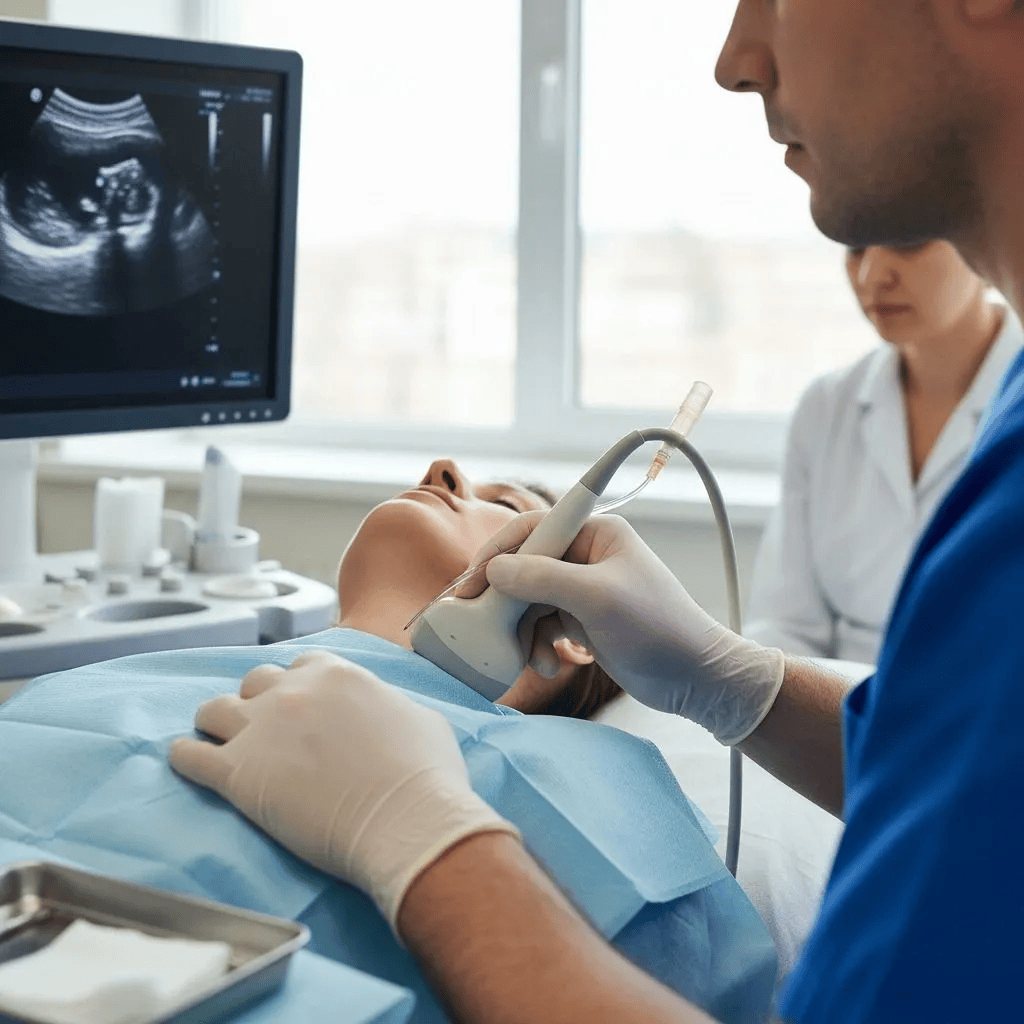
For a symptomatic cystic nodule, the first and simplest intervention is aspiration — draining the fluid using a fine needle under ultrasound guidance. The procedure is essentially identical to a standard FNA biopsy in terms of technique and comfort. It is done in a physician’s office under local anesthetic and takes only a few minutes. Aspiration provides immediate relief for most patients.
The limitation of aspiration alone is that cysts frequently recur. The fluid drains away, but the cyst wall remains intact and the cyst may refill over weeks to months. Studies show that simple aspiration without additional treatment results in recurrence in the majority of cases. This is why aspiration is often the first step rather than the complete answer.
The Most Effective Treatment: Ethanol Ablation
Ethanol ablation — also called percutaneous ethanol injection — is the preferred treatment for most symptomatic cystic thyroid nodules. After the fluid is aspirated, a small amount of medical-grade alcohol (ethanol) is injected directly into the cyst cavity. The ethanol destroys the inner lining of the cyst wall, causing it to collapse and adhere to itself rather than refilling.
The procedure is performed in an office setting under local anesthetic and typically takes 15 to 20 minutes. Published outcomes are excellent — studies show nodule volume reduction of 80 to 95% in most patients, with very low recurrence rates compared to aspiration alone. It is safe, effective, and widely considered the standard of care for symptomatic benign cystic thyroid nodules in practices that offer it.
Ethanol ablation for thyroid cysts requires a physician who is familiar with the technique and comfortable performing it under ultrasound guidance. Not every endocrinology or radiology practice offers it routinely. If you have a symptomatic cystic nodule and your physician has only mentioned aspiration or surgery as options, it is entirely reasonable to ask specifically whether ethanol ablation is available.
When RFA May Play a Role
Radiofrequency ablation is not the primary treatment for cystic nodules, but it is appropriate in specific situations. For nodules that are predominantly cystic but have a meaningful solid component, ethanol ablation addresses the fluid portion well but may not adequately treat the solid tissue. In these mixed cystic-solid nodules, RFA targeting the solid component alongside ethanol ablation of the cystic portion can achieve better volume reduction than either technique alone.
RFA may also be considered for cysts that have recurred after one or more ethanol ablation treatments and continue to cause symptoms. A specialist who offers both techniques is in the best position to recommend which approach is most appropriate.
Surgery: When It Becomes Necessary
Surgery is rarely the first, second, or even third choice for a benign cystic thyroid nodule. Surgery becomes appropriate in a limited set of circumstances:
- Suspicious cytology on aspirated fluid — if pathology of the cyst contents suggests malignancy, surgical removal is the appropriate next step
- Large solid component with high-suspicion features — a mixed nodule with a solid area carrying concerning ultrasound characteristics may ultimately require surgery
- Failed ablation with persistent symptoms — a small number of cysts do not respond adequately to ethanol ablation or RFA, and surgery is a reasonable and definitive option for these patients
The Bottom Line
Cystic thyroid nodules are among the most reassuring findings in thyroid care. They are almost always benign, and for those that do need treatment, the options are minimally invasive, highly effective, and well-tolerated. Aspiration provides immediate relief. Ethanol ablation offers durable resolution for most patients. RFA adds value for mixed nodules or recurrent cases. Surgery is available as a last resort but is rarely needed.
If you have a symptomatic cystic nodule and have only been offered aspiration or surgery, ask specifically whether ethanol ablation is available. A specialist who offers the full range of minimally invasive options is the right physician for this conversation.
References
- Haugen BR, et al. 2015 ATA Management Guidelines for Thyroid Nodules and DTC. Thyroid. 2016.
- American Thyroid Association — Thyroid Nodules.
- ACR TI-RADS — Thyroid Imaging Reporting and Data System.
This article was written by John P. Sabra, MD FACS and is intended for patient education only. It does not constitute medical advice and does not replace a consultation with your physician. Individual patient circumstances, nodule characteristics, and clinical judgment determine the appropriate management for every patient.
More from the Options Besides Surgery series


Ready to Talk to a Specialist?
A thyroid specialist can review your specific results, answer your questions, and help you understand exactly what your next steps should be. The ATLAS network connects you with experienced thyroid and parathyroid expert physicians who focus on thyroid disease.
Find a Thyroid Specialist Near You →